

holistic wellness
Productivity
Healthy beverages


"This content is part of a student project at UCLA Extension. Any logos used might be slightly changed to indicate that this document is NOT a communication from the company represented by the changed logo. Any statements made in this content are the statements of the UCLA student and not of any company. This statement is made so that any reader will understand this document is part of a UCLA student project and NOT a communication from any existing company."
Buyer Persona: Founder Diego
Buyer’s Journey Stage: Decision
Head Keyword: founder follow-through plan
Long-Tail Keywords: founder meeting follow-up system; how founders stop losing decisions after meetings; how to assign owners and deadlines after meetings
Founders rarely lose momentum because they lack ideas. More often, they lose momentum because too many important decisions disappear after the meeting ends.
A conversation happens. Everyone agrees on the direction. A few action items are mentioned. Someone says, “I’ll take care of that.” Another person mentions a deadline. Then the call ends, Slack gets busy, another meeting starts, and by the next morning the team is no longer aligned on what was actually decided, who owns the next step, or when it needs to happen.
For fast-moving founders, that gap between conversation and execution creates serious friction. It slows delegation, weakens accountability, and forces the team to spend more time clarifying what was already discussed instead of moving forward.
That is why the real problem is not just note-taking. The real problem is follow-through.
If you are a founder managing recurring meetings, team updates, client conversations, hiring discussions, and product decisions, you need a lightweight system that helps you turn conversations into decisions, owners, and deadlines. You do not need more noise. You need more structure.
For founders evaluating Note Hero Pro, the goal is not only recording meetings. It is improving delegation, clarity, and follow-through after key decisions are made.
This is where a founder follow-through plan becomes useful.

Meetings create momentum, but they also create risk.
In startup and small business environments, meetings often happen quickly and with incomplete information. Founders are expected to absorb many inputs at once, make decisions under pressure, and then move immediately to the next thing. That pace creates a familiar problem: good conversations do not always turn into clear action.
A founder might leave a call believing that the next steps were obvious. The team might leave the same call with different interpretations. One person thinks a deliverable is due Friday. Another thinks it is due next week. Someone assumes an owner was assigned, but no one wrote it down. Another person remembers the general direction of the conversation but not the exact decision.
This is how execution friction begins.
Small mistakes in post-meeting documentation can create large operational problems:
The founder usually feels the cost first. Not because the founder caused the confusion, but because the founder is the one who must resolve it later.
A missing detail may seem small in the moment, but once it affects a product timeline, hiring decision, client promise, or internal handoff, the cost becomes real.
The problem is not that founders do not care about documentation. The problem is that documentation often happens in the least reliable way possible: from memory, from scattered notes, or from partial recaps written under time pressure.
Here is what usually breaks down after a busy meeting:
1. The decision was discussed, but not captured clearly
People leave with a general sense of direction, but there is no exact statement of what was approved or chosen.
2. The owner was implied, but not confirmed
One person thinks someone else owns the next step. No one explicitly documents responsibility.
3. The deadline was mentioned once, then forgotten
A date may come up verbally, but unless it is documented, it often disappears from the team’s working memory.
4. Action items sound obvious in the room, but vague later
After the meeting ends, “we should do this” becomes harder to execute than expected because it was never translated into a concrete next step.
5. Founders do not have time to write perfect recaps
This is one of the biggest issues. Even when founders know they should send a follow-up, they often move too quickly into the next demand.
The result is a repeated pattern: strong conversations, weak handoff, slower execution.
That is why founders need a follow-through system that is simple enough to use consistently, but structured enough to reduce ambiguity.

A useful founder meeting follow-up system does not need to be complicated. It just needs to make the next step visible.
At minimum, every important meeting should end with clarity around four things:
If even one of those elements is missing, the team is forced to reconstruct the conversation later. That creates friction, and friction slows growth.
A strong founder follow-through plan should also support:
The goal is not to create perfect documentation for every meeting. The goal is to create enough structure that the right people can move forward without confusion.
This matters especially for founders because founder time is expensive. Every repeated clarification, every forgotten decision, and every avoidable rework cycle consumes attention that should be spent on higher-value work.

Manual notes can work in small doses. But once meeting volume increases, they become harder to sustain.
Founders often move between:
In that environment, writing detailed recaps after every meeting is difficult. The founder may take some notes, but the notes are often incomplete, rushed, or optimized for memory rather than team execution.
This is where the system starts to fail.
Manual notes tend to create a few predictable issues:
The issue is not effort. The issue is repeatability.
A founder does not need another complex system to manage. A founder needs a lighter workflow that makes documentation easier to capture, easier to review, and easier to turn into action.
That is why more founders are looking at AI-supported documentation workflows. Not because they want more technology for its own sake, but because they want fewer execution mistakes after important conversations.
Note Hero Pro helps reduce post-meeting friction by making it easier to capture, review, and structure spoken conversations into usable documentation.
Instead of relying only on memory or fragmented notes, founders can use Note Hero Pro to support a more consistent meeting workflow. That matters in situations where decisions, ownership, and deadlines need to be clearly understood after the conversation ends.
A better documentation workflow can support:
In that sense, Note Hero Pro for startup delegation can support faster handoff between conversation and execution.
For a founder, the value is not just transcription. The value is operational clarity.
When documentation improves, handoff improves.
When handoff improves, execution improves.
When execution improves, the team moves faster with fewer misunderstandings.
This is especially important in founder-led environments where the team may be small, roles may overlap, and every missed follow-up has a visible cost.
Note Hero Pro is useful in that context because it supports a workflow where spoken decisions do not have to disappear the moment the meeting ends. Instead, the founder can work from a more structured record of what happened and what should happen next.
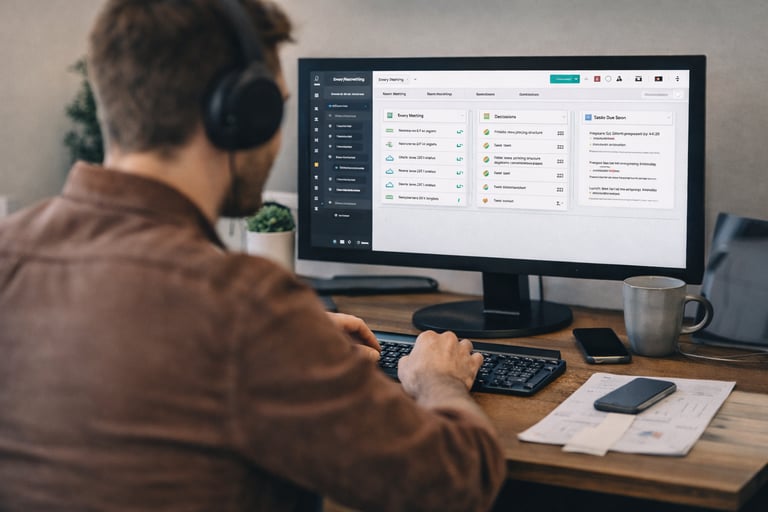
If you want a lightweight process you can apply immediately, use this simple framework after important meetings:
Step 1: Capture the conversation
Make sure the full conversation can be reviewed later, especially when multiple decisions, owners, and dates are involved.
Step 2: Confirm the decision
Before the next meeting begins, identify the one or two most important decisions that came out of the conversation.
Step 3: Assign one owner per next step
Avoid group ownership. Shared responsibility often becomes no responsibility.
Step 4: Add a deadline
If the next action matters, give it a date.
Step 5: Make the follow-up visible
A decision should not live only in someone’s head. It should exist in a format the team can review.
This sounds simple, and that is exactly the point. The best founder systems are usually simple enough to repeat under pressure.
One of the best ways to evaluate a meeting workflow is not to debate it endlessly, but to test it quickly.
A 7-day founder follow-through test could look like this:
Day 1: Choose one recurring meeting type:
Day 2: Capture the conversation and review the summary.
Day 3: Extract the key decisions, owners, and deadlines.
Day 4: Share the follow-up in a clear, structured format.
Day 5: Check whether the team interpreted the decisions correctly.
Day 6: Measure what felt faster:
Day 7: Decide whether the workflow reduced friction enough to repeat.
This kind of short test is useful for founders because it shifts the conversation from theory to workflow fit. Instead of asking, “Do I like this tool?” the better question becomes, “Did this reduce friction in a meaningful way?”
A founder at the decision stage usually asks questions like:
“Will this actually save time, or just create another step?”
A good system should reduce rework, not add admin.
“Will my team use it?”
That depends on how simple the handoff is. The easier the documentation is to review and act on, the better adoption will be.
“Does this fit my current workflow?”
That is why a short implementation plan matters. Founders need a realistic way to test fit before committing fully.
“How do I know if the value is real?”
That is where an ROI-style view becomes useful. If better documentation reduces repeated clarifications, missed owners, and delayed follow-up, the value becomes easier to see.
For teams comparing options, the real question is whether an AI meeting recorder for startups can reduce friction after meetings, not just capture audio.
These questions are reasonable, and they are exactly why decision-stage content should focus on practical fit, not just generic product benefits.

If your meetings produce ideas, but your team still loses momentum after the call, the issue may not be the quality of the conversation. The issue may be the lack of a repeatable follow-through system.
A founder follow-through plan helps create clarity around what was decided, who owns the next step, and what needs to happen next. That kind of structure is not just helpful. In fast-moving teams, it can become a competitive advantage.
If you want to test whether a more structured documentation workflow can reduce execution friction, the next step is simple:
Review the Founder Follow-Through Plan and use it to test a lightweight system for turning conversations into decisions, owners, and deadlines.